Doping The Bean
Inside the Fermentation Wars Splitting Specialty Coffee in Half
Four coffees scored 95 points or higher at the 2024 Best of Panama, one of the most prestigious competitions in the world. All four were disqualified. The Specialty Coffee Association of Panama called them "altered from their natural DNA expression, with the intent to score higher and win by using foreign additives." The president of the SCAP, J. Hunter Tedman, used a word that coffee professionals don't use lightly: cheating.
The coffees in question were co-fermented — green beans processed alongside fresh fruit, cultured yeast, or other external ingredients during fermentation. It is, depending on who you ask, either the most exciting innovation in specialty coffee since single-origin sourcing or a repackaging of the flavored coffee trend that the third wave spent two decades defining itself against. George Howell, the man who co-founded the Cup of Excellence and sold The Coffee Connection to Starbucks for $23 million, has been unequivocal: "You wipe out the very miracle of what coffee can taste like." Meanwhile, Coffee Review — the industry's most widely read scoring publication — gave a co-fermented Hawaiian lot 98 points and placed it first on its 2024 Top 30 list. The miracle, it seems, is in the eye of the cupper.
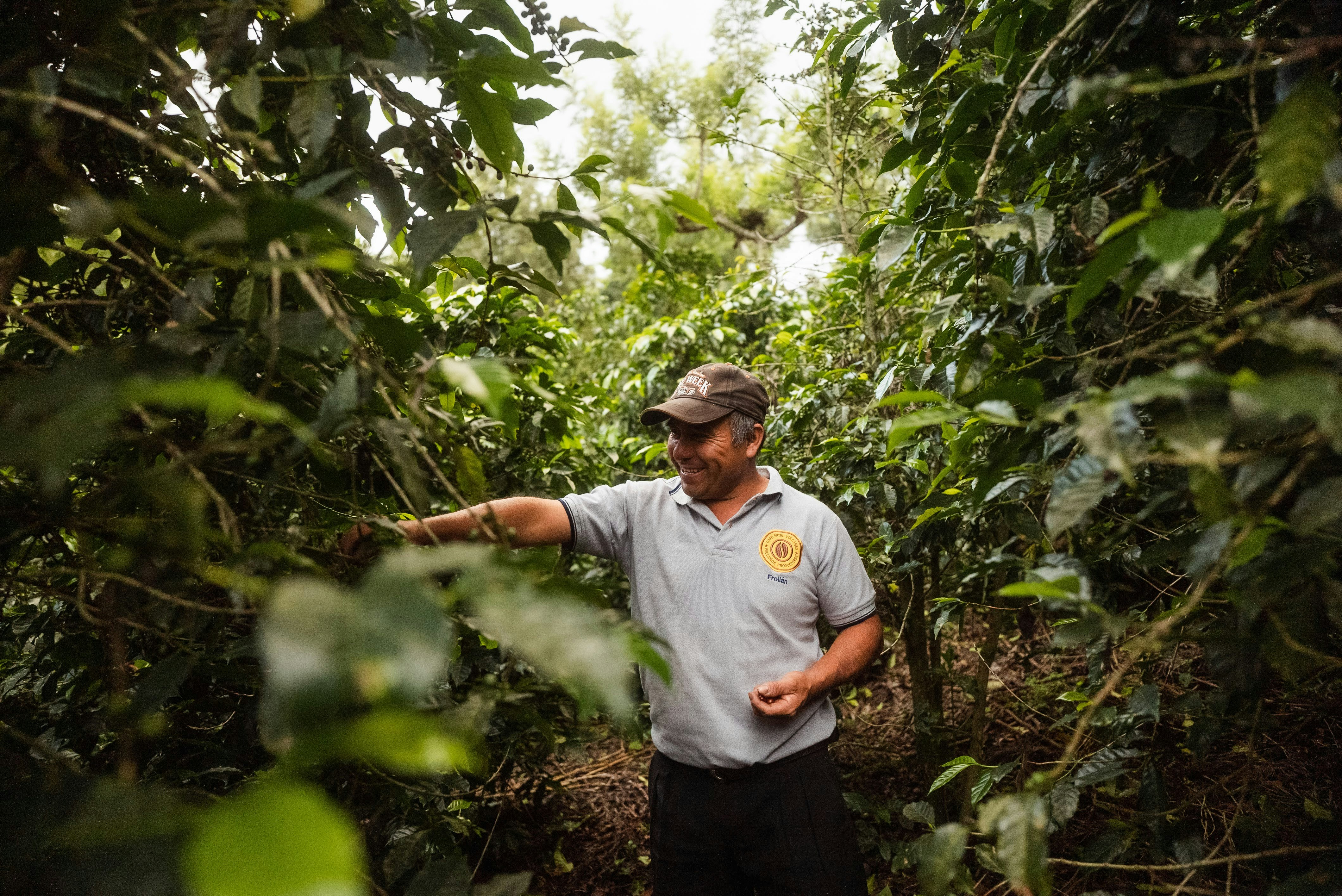
All coffee ferments. This is the first thing to understand, and the thing the debate most frequently obscures. When a cherry is picked, wild yeasts and bacteria begin consuming the sugars in the mucilage — the sticky fruit layer surrounding the seed. This microbial activity generates volatile organic compounds — esters, aldehydes, organic acids — that migrate into the bean and shape everything you'll eventually taste in the cup. Whether a producer washes the mucilage off, leaves the whole cherry to dry intact, or splits the difference with honey processing, fermentation is happening. It has always been happening. Coffee without fermentation is not coffee.
Co-fermentation modifies this process by introducing something from outside — guava pulp, galaxy hops, aji chili peppers, cultured Saccharomyces cerevisiae, koji spores. The added material participates in the living chemistry: its sugars are metabolized by microorganisms alongside the coffee's own sugars, and the resulting flavor compounds are generated in situ. This is not, technically, the same thing as adding hazelnut syrup to a latte. A producer in Colombia's Quindio region might seal fresh guava into a fermentation tank for 48 to 96 hours, allowing the fruit's sugars and wild microbes to interact with the mucilage. The Hachi Coffee Project — a collaboration between Colombian producer Diego Bermudez and Panamanian grower Allan Hartmann — reports that only 3% of the fruit used in their process ends up in the final cup. The fruit is a catalyst, not an ingredient. It changes what the microorganisms do, not what the coffee tastes "of" in any literal sense.
That, at least, is the argument. Whether you find it persuasive may depend on whether you've ever tasted a co-fermented lot described as "ginger ale Geisha" and thought: this is extraordinary, or this is an abomination.
---
The technique did not come from coffee. It came from wine.
Carbonic maceration — whole grapes fermented in sealed, CO2-flushed vessels to produce fresh, fruity wines with low tannins — was developed in France's Beaujolais region in the 1930s. Eighty years later, a Colombian farmer named Camilo Merizalde and an Australian barista named Sasa Sestic adapted the method for coffee cherries, sealing them in anaerobic tanks and flushing with carbon dioxide to suppress acetic acid while amplifying aromatic complexity. When Sestic used the resulting coffee to win the 2015 World Barista Championship, the technique crossed from experiment to movement almost overnight.
But Sestic was only the most visible point of contact in a broader migration. Lucia Solis, a winemaker trained at UC Davis, was hired in 2014 by Scott Laboratories — a major yeast supplier to the wine industry — to expand their market in Baja Mexico. When the grape harvest ended, Scott Labs sent her to Central American coffee mills with cultured yeast strains in a backpack. She has since become one of the most prominent fermentation consultants in specialty coffee, designing controlled protocols for producers across Latin America. She brought the science of inoculation — selecting specific microbial strains for specific flavor outcomes — directly from Napa Valley to the highlands of Guatemala. La Palma y El Tucan, a farm in Cundinamarca, Colombia, pioneered lactic acid fermentation in coffee using Lactobacillus cultures — the same genus responsible for malolactic conversion in wine and the tang in sourdough bread. Carlos Pola in El Salvador began experimenting with both carbonic maceration and cold fermentations around 2018. The 2019 World Coffee in Good Spirits Champion, Dan Fellows, won using Pola's frozen fermented Pacamara.
The vocabulary followed the technique. Terroir. Varietal expression. Natural process. Coffee's entire premium language is borrowed wholesale from wine. Co-fermentation just made the debt explicit.
---
Colombia, which was the world's largest supplier of washed arabica as recently as 2019, has become the undisputed center of co-fermented production. The shift represents what one industry publication called "a dramatic break from decades of FNC orthodoxy" — the Federacion Nacional de Cafeteros having spent generations enforcing consistency and uniformity in Colombian coffee's global profile. Now, the country's 560,000 smallholder farmers are doing something closer to the opposite.
The economic logic is blunt. Traditional washed lots struggle to command the premiums they once did. Co-fermented micro-lots can double a producer's income. Demand growth is concentrated in China and the Middle East — markets with no sentimental attachment to what Colombian coffee used to taste like. China moved from Colombia's 18th export destination in 2019 to its 6th-largest by 2023. These buyers want bold, expressive flavor profiles, and co-fermentation delivers them with a consistency that terroir alone cannot.
Edwin Norena, at Finca Campo Hermoso in Quindio, develops co-fermented coffees using mossto — fermented coffee pulp analogous to wine must — combined with fruit, galaxy hops, and aji chili peppers. His Black Ginger Ale Geisha, a double carbonic maceration lot, delivers tasting notes of ginger, lime, and margarita mix. At El Vergel Estate in Tolima, producers sprinkle koji spores — Aspergillus oryzae, the same filamentous fungus that makes miso and sake possible — over coffee cherries, maintaining temperatures between 25 and 30 degrees Celsius to activate enzymatic breakdown. The estate tested koji across Geisha, Bourbon, Caturra, and Java varieties. Java responded best, gaining one to two-and-a-half cup score points. Diego Bermudez, who debuted at the 2018 Cup of Excellence Colombia and fetched the highest auction price at $54.10 per pound, pioneered double anaerobic washing and thermal shock processing now emulated across the country.
These are not fringe operators. They are defining what Colombian coffee will mean for the next generation.
---
The opposition is led by people who earned the right to be skeptical. George Howell — who spent the 1990s working on economic sustainability models for coffee farmers under the United Nations before founding George Howell Coffee in 2004 — frames co-fermentation as "a new age of flavored coffee." The invocation is deliberate. Flavored coffee — hazelnut, vanilla, Irish cream — is the original sin of the specialty world, the commodity-era trick that the third wave built its identity against. To compare co-fermentation to flavoring is to deny it legitimacy at the most fundamental level.
Howell's argument has a structural dimension beyond taste. If a coffee's highest-scoring attributes come from added strawberries rather than from its varietal character and growing conditions, the scoring system rewards the additive, not the farmer's skill or the land's potential. The narrative of terroir — the idea that a Geisha grown at 1,800 meters in Boquete, Panama tastes different from a Geisha grown at 1,200 meters in Huila, Colombia because of the specific intersection of soil, altitude, and microclimate — collapses if both can be made to taste like watermelon.
Brazilian barista Emerson Nascimento, a two-time World Coffee in Good Spirits Champion, put it in competitive terms: highlighting strawberry notes in a strawberry co-fermented coffee is counterproductive because "the flavours will be so pronounced" that the barista's extraction skill becomes irrelevant. The coffee does the work. The craftsperson becomes unnecessary.
And then there's the transparency problem. Some co-fermented coffees taste so distinctly of their additive — "otherwise they wouldn't taste like ginger ale or hops," as one Royal Coffee trader observed — that the line between fermentation and flavoring blurs in practice, even when it holds in theory. The 3% figure from the Hachi Project is compelling, but it comes from a single producer group and hasn't been independently verified. Marty Pollack of Torch Coffee in China may have the most pragmatic position: "The main point is not fighting about the terms but rather asking everyone to be transparent about what was done to a coffee during and after the fermentation and drying stages."
---
The regulatory landscape, in the meantime, is a contradiction performing itself in real time. The SCA updated its World Barista Championship rules in 2024 to explicitly permit co-fermented coffees — provided all additives are introduced before the green coffee stage. The Best of Panama, that same year, disqualified them as cheating. The WBC says yes with conditions. The SCAP says no, categorically. Notably, no competitors actually used co-fermented coffees at the 2024 WBC despite the new rules. The permission exists. Nobody took it.
At the 2025 Re:co Spotlight event in Houston, the SCA convened a citizens' assembly-style gathering to address what it calls the "green coffee identity" question. One side argued that "100% pure coffee" is a myth — foreign substances inevitably enter beans during any processing method. The other side emphasized transparency rights and fair competition. The organization identified multiple possible classification axes: distinguishing by additive nature, by timing, by function, by creative intent. As of early 2026, the SCA remains "still sifting through all the information."
Which is to say: the institution responsible for defining specialty coffee cannot currently define it.
---
There is a version of this story in which the purists win. Co-fermentation is a fad, like nitrogen-infused everything was a fad, and the industry returns to the terroir-driven orthodoxy that built it. George Howell is vindicated. The competitions close the loophole. The ginger ale Geisha becomes a footnote.
There is another version in which it doesn't matter what the purists think, because the economics have already decided. When a Colombian smallholder can double their income by adding guava to a fermentation tank, and when the fastest-growing coffee markets in the world — China, the UAE, Saudi Arabia — specifically prefer the results, the aesthetic argument becomes a luxury that only people who don't grow coffee can afford to make. Edward Fischer, the Vanderbilt anthropologist who documented how the third wave's narratives of provenance and craftsmanship created symbolic value that never reached the farmers, might note the irony: the technique that the industry's tastemakers call inauthentic is the one that most directly improves producer livelihoods.
And there is a third version — probably the most likely — in which co-fermentation becomes its own category, the way natural wine became its own category, the way sour beer became its own category. Not replacing tradition. Existing alongside it. Luis Sanchez, an agronomist and producer in Guatemala, has been saying this for a while: "We should always be clear and label these coffees as co-ferments, so consumers know that the sensory profile has been modified." Andrea Pacas, a producer and industry figure, offered something more expansive: "It's time to stop looking at the waves and start looking at the entire ocean."
Every fermented product — wine, cheese, beer, chocolate, coffee — eventually has this argument. Tradition versus experiment. Purity versus possibility. The resolution is never one side winning. It's the vocabulary expanding until both sides have a name.