Another Radical Wave
From Folgers to Fermentation: How a Norwegian Roaster's Manifesto Turned a Grocery Aisle Commodity into a $100 Billion Obsession
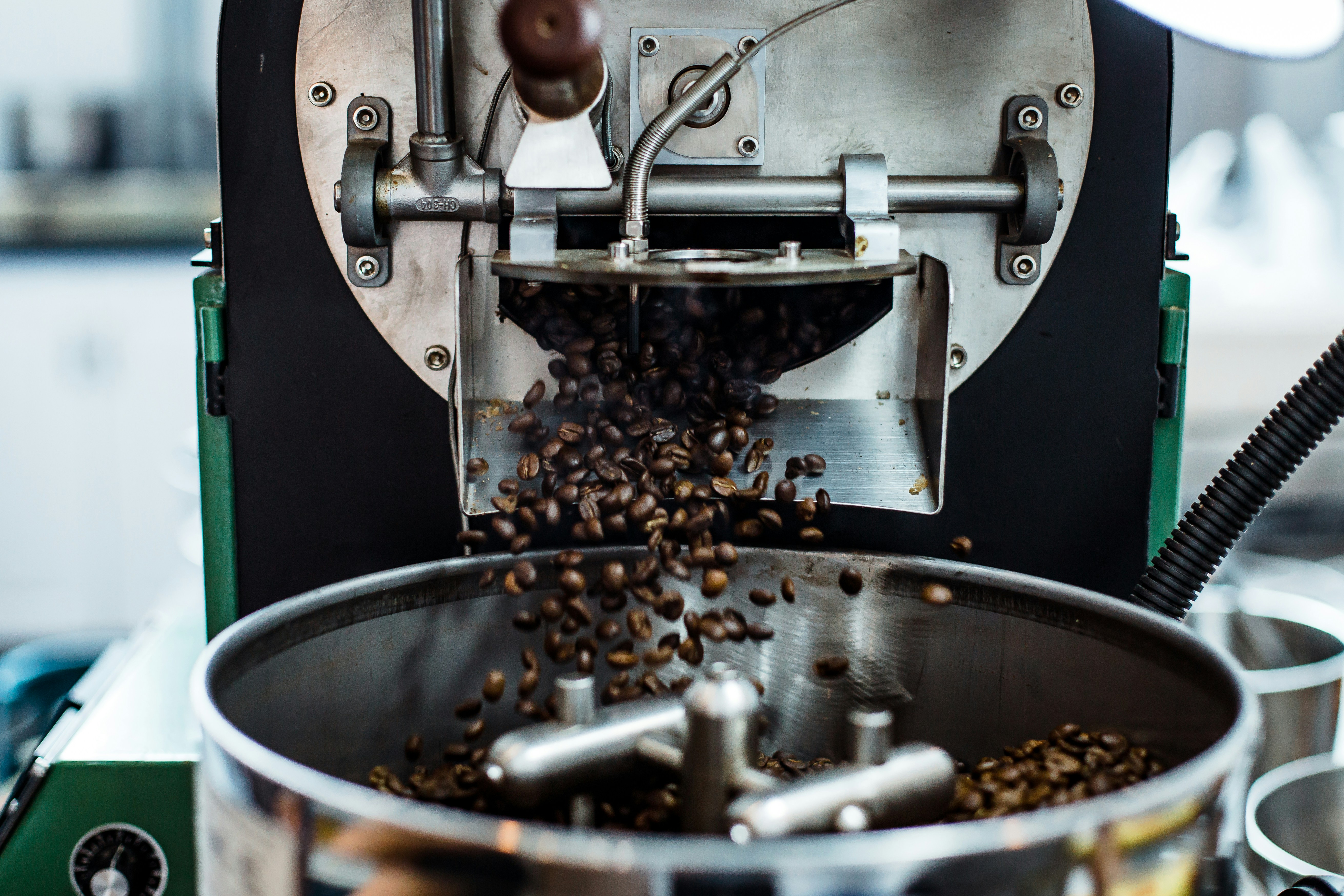
There is a photograph—undated, uncredited, probably taken on a phone—of Duane Sorenson standing in front of a former beauty parlor on Southeast Division Street in Portland. The sign still reads "The Hair Bender." Inside, Sorenson is roasting coffee beans in a space that until recently smelled of peroxide and hairspray. It's 1999. He will name his most iconic espresso blend after the salon. Within sixteen years, a Luxembourg-based holding company will purchase his entire operation as part of a multi-billion-dollar portfolio that includes Keurig. But for now, it's just a man and a drum roaster and a conviction that the brown liquid Americans have been drinking since the Civil War deserves better than what it's getting.
This is not a story about coffee, exactly. It's a story about how a commodity becomes a culture—how a substance sold as freeze-dried crystals in tin cans transformed, within a single generation, into the subject of international championship, academic ethnography, and the kind of reverence previously reserved for natural wine and first-pressing olive oil. The throughline from Folgers to a $16 cortado at a minimalist café in Williamsburg is shorter and stranger than you'd think.
The term "third wave" entered coffee's lexicon the way most consequential ideas do—buried in an industry newsletter almost nobody read. In the November 2002 issue of *The Flamekeeper*, a modest publication of the Roasters Guild, a Norwegian-based roaster named Trish Rothgeb outlined a framework borrowed from feminist theory: three successive waves, each with its own relationship to the bean. The first wave was Folgers on every table—coffee as utility, as wallpaper. The second was Starbucks—coffee as experience, as lifestyle branding, as an excuse to spend four dollars and sit in a leather chair. The third, Rothgeb argued, was something else entirely: coffee as craft, as agriculture, as an object worthy of the same scrutiny applied to a Burgundy or a high-altitude Nebbiolo.
Rothgeb wasn't the first to use the phrase. A specialty broker named Timothy Castle had dropped "Coffee's Third Wave" into a *Tea & Coffee Trade Journal Asia* column three years earlier. But Castle's usage passed without consequence. Rothgeb's stuck—partly because of its intellectual elegance, partly because she went on to become a Q Grader, a Q Trainer, a WBC Board member, and a co-creator of the World Coffee Roasters Championship. She wasn't just naming a movement; she was building its infrastructure from the inside.
Six years later, the definition that actually reached civilians came from an unlikely source. Jonathan Gold—Pulitzer Prize-winning food critic, the man who made strip-mall Thai restaurants canonical—reviewed La Mill coffee in *LA Weekly* and wrote: "We are now in the third wave of coffee connoisseurship, where beans are sourced from farms instead of countries, roasting is about bringing out rather than incinerating the unique characteristics of each bean, and the flavor is clean and hard and pure." Concise, evocative, and published in a mainstream outlet. This was the sentence that gave the movement its elevator pitch.
---
But movements don't begin with definitions. They begin with people who are dissatisfied.
Erna Knutsen was a Norwegian immigrant working as a secretary at a San Francisco coffee trading firm when she started pulling aside the interesting beans—the ones that arrived from specific microclimates and tasted like something other than charcoal and regret. In 1974, she coined the term "specialty coffee" in an interview with the *Tea & Coffee Trade Journal*, decades before anyone was thinking in waves. She died in 2018 at ninety-six. The Specialty Coffee Association called her the godmother of the industry. She had spent her career insisting that a coffee cherry grown at altitude in Guatemala and a coffee cherry grown at sea level in Brazil were not the same product—a claim that now seems obvious but at the time was borderline heretical in a market designed around uniformity.
George Howell, who founded The Coffee Connection in Boston in 1975, took Knutsen's insight and gave it a consumer-facing philosophy: coffee as "a noble beverage worthy of being in the same league as fine wine." He built twenty-four stores across the Northeast, sold the whole thing to Starbucks in 1994 for $23 million, and then—in the kind of narrative arc that only the truly obsessed can produce—co-founded the Cup of Excellence in 1999, an international estate coffee competition designed to break the commodity price cycle that was destroying the farmers he'd spent his career celebrating. The Oscars of the coffee world, people call it now. Howell was in his sixties.
Then there's David Schomer, a former Boeing engineer who opened Espresso Vivace in Seattle in 1988 and became to latte art what Rei Kawakubo is to deconstruction—the person who systematized what others had only gestured at. He saw Milanese baristas pouring shapes into milk, brought the technique home, sent his entire staff on a field trip to observe microfoam at a competing café, and published *Espresso Coffee: Professional Techniques* in 1996, a book that the industry still calls its bible. The Seattle Times described him as "as influential in the gourmet coffee world as Starbucks CEO Howard Schultz is in the mainstream coffee industry." Schomer would probably consider that an insult.
---
The Big Three—Intelligentsia, Counter Culture, Stumptown—were all founded within four years of each other, in three different cities, by people who didn't know they were part of the same movement.
Doug Zell opened Intelligentsia in Chicago's Lakeview neighborhood in 1995 because he'd moved from San Francisco and found good coffee "surprisingly elusive." His green buyer, Geoff Watts, formalized something called Direct Trade—bypassing brokers entirely, visiting farms, paying premiums, publishing prices. It became the industry template. Brett Smith and Fred Houk, two UNC business school graduates inspired by a Smithsonian sustainability conference, started Counter Culture the same year in Durham, in a former tobacco warehouse. Their first customer was a trattoria called Pop's. Sorenson arrived four years later, in the hair salon.
All three companies shared an ethos that would have been unintelligible to the previous generation of coffee entrepreneurs: that the barista was a craftsperson, not a counter worker; that a bean's origin story mattered as much as its flavor; that transparency—about sourcing, pricing, roasting philosophy—was not a marketing strategy but a moral imperative. The simplified menu, the pour-over bar, the insistence on weighing doses to the tenth of a gram—these weren't affectations. They were arguments about what coffee could be.
The Big Three also share a more complicated legacy. In October 2015—the same month, as if coordinated by some invisible hand of consolidation—Peet's Coffee acquired both Stumptown and a majority stake in Intelligentsia. Peet's was itself owned by JAB Holding Company, a Luxembourg-based conglomerate that had purchased it for roughly $1 billion three years earlier and would go on to acquire Keurig Green Mountain for $13.9 billion. "Shock waves reverberated through the world of coffee geekery," reported Food Republic. Only Counter Culture—the quiet one, the one from Durham—remains independently owned today.
---
If the third wave had a shadow curriculum, it was Japanese. The Hario V60 dripper—sixty-degree cone, spiral ridges, single large drainage hole—was designed by a Tokyo company established in 1921 and became the movement's most recognizable tool, its equivalent of the Bialetti Moka pot or the Chemex. The siphon brewer, adopted by third wave cafés as a theatrical, high-precision spectacle, was first produced in Japan in 1925 for kissaten owners—the proprietors of traditional coffee houses that had been practicing meticulous single-cup brewing for generations before anyone in Portland had heard of terroir. The nel drip method, the Kono paper filter dripper, the culture of exactitude and slow attention—all of this was Japanese before it was Californian.
When Blue Bottle Coffee opened its Tokyo flagship in Kiyosumi-shirakawa in 2015, it was entering a market with decades of precedent for everything it was selling as new. James Freeman—who'd started as a struggling classical clarinetist roasting seven-pound batches in a $600-a-month potting shed in Oakland with $15,000 in credit card debt—was bringing coals to Newcastle, or perhaps more accurately, bringing pour-overs to the country that invented them. Two years later, Nestlé acquired a 68% stake in Blue Bottle for roughly $500 million. Freeman became Chief Product Officer. The potting shed was a long time ago.
---
The Nordic countries deserve their own parenthetical. Norway, Denmark, Sweden, Finland—they drink more coffee per capita than almost anywhere on earth, and they roast it lighter than anyone. The Scandinavian approach—dropping beans thirty to sixty seconds after first crack, often in under ten minutes, preserving acidity and fruit-forward character—became the third wave's defining aesthetic. Tim Wendelboe, the 2004 World Barista Champion, operates a micro roastery in Oslo's Grünerløkka neighborhood that was named the world's best in 2013. He has won the Nordic Roaster Championship eight times. Rothgeb was working in Norway when she wrote the essay that started everything. This was not a coincidence.
In Melbourne, there are more than 2,100 independent coffee shops. Australia is the only country where Starbucks was forced to scale back operations—not because of regulation, but because the local independent scene was simply too good, too entrenched, too sophisticated for a chain to compete. The flat white—smaller, stronger, microfoam-topped—became Australian coffee culture's ambassador abroad. In Seoul, specialty coffee became inseparable from youth culture and minimalist design. In Bogotá and São Paulo, farm-to-cup cafés began serving domestic consumers the same beans that had been exported for a century. The waves, it turned out, didn't move in one direction.
---
The numbers now: the global specialty coffee market was valued at approximately $101.6 billion in 2024, projected to reach $183 billion by 2030. In 2024, for the first time, past-day specialty coffee consumption in the United States surpassed traditional coffee—45% of American adults reported drinking specialty in the past day, an increase of 80% since 2011. The 25-to-39 demographic leads at 66%. Ready-to-drink coffee surged 83% in a single year.
These are not the statistics of a niche. This is what happens when a commodity becomes a culture and then a culture becomes a market and then a market becomes an industry worth consolidating. JAB Holding's coffee acquisitions alone total well over $15 billion. La Colombe was purchased by Chobani for $900 million, driven largely by its Draft Latte—a canned nitrous-oxide-injected cold latte that captured over 1% of the entire U.S. ready-to-drink coffee market within eighteen months. The Draft Latte is not what Trish Rothgeb was writing about in *The Flamekeeper*. But it is, arguably, her creation's furthest logical extension: an artisanal product scaled until it is, once again, a commodity.
---
There's a counternarrative, and it's worth hearing. Edward Fischer, an anthropologist at Vanderbilt, spent years working with Maya coffee farmers in Guatemala and third wave tastemakers in the United States. His conclusion was not comfortable: "The quest for artisanal quality in the coffee market perpetuates classic dependency patterns of global capital accumulation." The story of origin that commands a premium at a Williamsburg café does not translate to proportional benefit for the people who grew the beans. The farmers lacked, as Fischer put it, "the social and cultural capital needed to extract surplus symbolic value from their crops." In other words, the narrative is the product. And narrative is something you need cultural infrastructure to produce.
There's also the gentrification question—the one that follows third wave coffee into every historically working-class neighborhood it enters. In Portland's Albina District, shaped by decades of redlining and racial exclusion, real estate prices rose from $5,000 during the 1990s disinvestment era to $600,000 by 2020—a 120-fold increase—with specialty cafés serving as both markers and engines of the transformation. In Los Angeles, the 2017 opening of Weird Wave Coffee in Boyle Heights drew organized community resistance. Harvard Business School research found that the presence of coffee shops alone correlates with a 0.5% increase in local house prices. The third wave's progressive self-image and its material consequences exist in a tension that the movement has never fully resolved.
---
Discussion of a fourth wave has been intensifying since the early 2020s. No one agrees on what it means. Democratization and scale, says one camp. AI-driven roasting and blockchain-verified sourcing, says another. Home-centered consumption driven by CoffeeTok influencers, says Mintel. Structural reform—livable wages, ownership equity, climate resilience—says the academic left. Cosimo Libardo of Ceado has suggested abandoning the wave metaphor entirely: "Waves seem to describe a sequence of events, but today's transformation happens multi-dimensionally."
Andrea Pacas, a producer and industry figure, offered something more poetic: "It's time to stop looking at the waves and start looking at the entire ocean."
Perhaps. But oceans are harder to name, harder to market, harder to fit into an investor deck or a newsletter essay. The wave framework endures because it does what good frameworks do—it simplifies a complicated history into a story with a beginning, a middle, and the tantalizing suggestion of a next chapter. Whether that next chapter belongs to the farmers, the algorithms, the influencers, or some as-yet-unimaginable synthesis is the question the industry is currently living inside. The beans, as always, are indifferent.